A development freeze is the wrong migration bargain
A development freeze shifts migration risk onto the business. Learn how module cutover keeps production moving without a dangerous big bang.
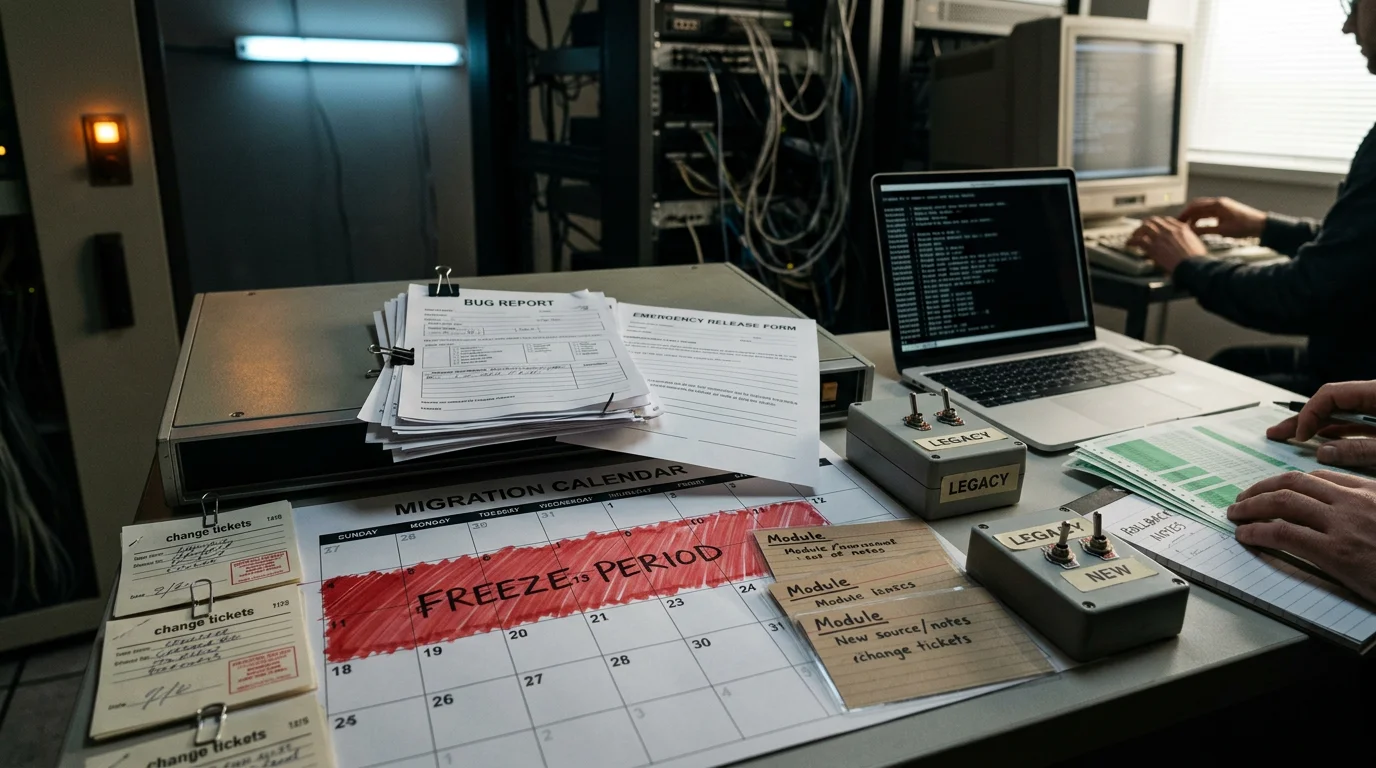
A development freeze makes a migration easier to manage by making the business harder to run. The vendor gets a stable source tree, while product teams queue revenue work, regulatory changes, defect fixes, and operational improvements behind an arbitrary cutover date. That bargain can look tidy on a project plan and still be reckless in production.
I have seen freezes announced as a two-week precaution and then renewed because a reconciliation failed, a batch window ran long, or nobody trusted the rollback. The cost is not confined to idle developers. Work keeps arriving, so it moves into side branches, spreadsheets, manual operations, and promises to customers. A safer migration removes the need for one decisive switch. It moves bounded behavior a module at a time, proves parity on real traffic, and leaves the old system serving everything that has not moved.
Vendors ask for a freeze because it simplifies their comparison
A vendor asks for a development freeze to stop the source system changing while the replacement is built and tested. If the old code, schema, job schedule, and interfaces stay fixed, the vendor can compare one static baseline with one candidate release. Scope control becomes easier, test results age more slowly, and every late defect cannot be blamed on a moving target.
That request makes sense inside a big-bang delivery model. A team takes a copy of the system, interprets it, rebuilds it elsewhere, runs acceptance tests, and switches all users on a chosen date. Any production change after the copy creates another difference to discover and reproduce. The migration team therefore treats normal development as contamination.
The awkward part is that the model creates the condition that supposedly requires the freeze. When the replacement must match the entire system at once, a change anywhere can affect the final comparison. If the unit of migration is a customer statement module or an order-pricing path, a change in an unrelated payroll export should not disturb its cutover. Broad freezes are often evidence that the vendor has no reliable boundary between what is moving and what is staying.
There are legitimate short controls. A database switchover may need a write pause measured in minutes. A release window may block deployments for an evening. A schema transition may prohibit one class of destructive change until both versions understand it. Those are targeted operational controls with an owner, a start condition, and a tested exit. Calling a multiweek ban the same thing hides a much larger transfer of risk.
Ask the vendor to name the exact artifact that must remain stable. Is it a table shape, an interface contract, a set of batch outputs, or every line in the repository? Then ask what comparison fails when that artifact changes. A precise answer exposes a manageable dependency. “The project needs stability” exposes a delivery method that cannot absorb ordinary business motion.
The business pays for work that merely waits
The visible cost of a freeze is the backlog accumulated during it. The larger cost is the coordination needed to preserve, rebase, retest, and release that work after the migration. Nothing stopped changing outside the repository. Tax rules take effect, partners revise file formats, customers find defects, security teams set remediation dates, and operations staff learn new exceptions.
Finance should price the freeze as delayed outcomes plus recovery work, not as developer salaries for the frozen period. A useful ledger has four columns: the blocked change, the date it would normally ship, the consequence of delay, and the effort to reconcile it after cutover. Consequences should be stated in business terms such as missed invoicing, manual cases per day, contractual exposure, or a sales commitment at risk. Avoid invented precision. A range with an accountable owner is more honest than a fictional total.
The queue also has nonlinear cost. Two changes made against the same old function may merge cleanly on their own and conflict once the replacement reorganizes that behavior. A schema patch designed for the legacy database may have no direct home in the new model. Test evidence collected before the freeze may no longer apply after ten queued releases land together. The business does not simply resume its previous pace on day one after cutover.
Hidden work appears before the freeze as well. Teams rush borderline changes into the last permitted release. Review quality drops because everyone wants to beat the gate. Operations creates temporary manual procedures for work that missed it. Product managers split features around the restriction, producing intermediate states nobody would otherwise choose. These are migration costs even when the vendor's statement of work excludes them.
I use one blunt test in steering meetings: if a production defect appears during the freeze, who may change the old system, and who must reproduce that fix in the replacement? “We will decide then” is not an answer. The team needs a written path for emergency fixes, including authority, turnaround, regression tests, and how the equivalent change reaches the new code. Without it, the freeze is a hope that production will behave.
A freeze relocates risk instead of reducing it
A broad freeze reduces configuration drift for the migration team but increases operational, commercial, and release risk for everyone else. Risk has moved, not disappeared. That distinction matters because a green migration dashboard can coexist with a growing pile of unsafe deferred changes.
The first relocated risk is production exposure. A defect or vulnerability that would normally receive a routine release now needs an exception. Exceptions become political because granting one appears to threaten the migration date. People start weighing the optics of disturbing the program against the actual impact of leaving the flaw in place.
The second is change concentration. When the freeze lifts, the organization releases the migration and a compressed backlog near each other. Even if each change passed its own tests, their interaction has received little production evidence. Incident responders then face a new architecture, new deployment procedures, and several product changes at once. This is the worst possible time to make causality ambiguous.
The third is knowledge decay. A developer who completed a change before the freeze may be working elsewhere when it finally ships. The business analyst who understood an exception may have forgotten the edge case. A branch can retain code, but it cannot preserve every conversation that made the code correct.
Treat freeze duration as an exposure metric. Count from the last ordinary production release until ordinary releases resume, not just the dates printed under “code freeze” in the migration plan. Include stabilization extensions and the time required to drain queued work. Then put the following signals beside it:
- production fixes awaiting an exception;
- changes held outside the main branch;
- manual procedures created because software could not change;
- interfaces that changed upstream during the restriction;
- queued releases that will land after cutover.
If those numbers rise while migration status remains green, governance is measuring the vendor's convenience rather than the company's risk.
Module boundaries make independent change possible
Module-by-module cutover removes the need for a systemwide freeze by giving each slice its own contract, parity test, routing rule, and rollback path. “Module” does not have to mean a neat package in the old source. It means a bounded business capability whose inputs, outputs, state ownership, and side effects can be observed.
Good first slices have a narrow entry point and consequences the team can reconcile. Document rendering, a read-only account view, a tax calculation, or one batch export may qualify. The easy-looking screen backed by fourteen shared tables usually does not. Choose by behavioral boundary, not by the legacy directory tree.
The boundary needs a written contract before anybody rewrites code. Record accepted inputs, emitted outputs, error behavior, timing assumptions, data ownership, and every external side effect. Include ugly behavior that consumers rely on. A blank date that becomes 1900-01-01 may look like a bug, but changing it during migration can break a downstream comparison. Modernization can remove that behavior later through an explicit product decision.
A minimal cutover inventory can look like this:
slice: invoice-pdf
entry: POST /internal/invoices/{id}/render
reads: invoice, customer, tax_snapshot
writes: rendered_document
side_effects: object_store.put, audit.append
parity: status, content_hash, audit_code
route_key: tenant_id
rollback: route tenant to legacy renderer
owner: billing-platform
This artifact prevents a common failure: a team declares the new module equivalent because its primary output looks right while an audit row or retry code silently differs. It also gives operations a concrete rollback action. If a slice cannot name its route key or state owner, it is not ready for independent cutover.
The cutover map should expose calls that cross the proposed boundary. Trace one ordinary request and one failure from entry point to final side effect. If the invoice renderer asks the legacy application to calculate tax, fetch customer preferences, assign a document number, and append an audit record, then “renderer” describes only the visible function. The team must either keep those calls as explicit legacy dependencies or widen the slice. Pretending they are implementation details produces surprises during routing.
Sequence slices by dependency direction. A module that many other paths call can be useful early because it creates a stable contract for later work, but only if its blast radius is acceptable. A leaf capability may offer a safer rehearsal of capture, comparison, and rollback. There is no universal order. The map should show why each slice comes next and which dependency it removes.
Also distinguish data copy from data ownership. Copying customer rows into Postgres does not make the candidate authoritative. Name which path may create, amend, and delete each record during every migration state. Readers can tolerate temporary duplication; they cannot tolerate two writers making independent promises about the same invoice. This state table is often more useful than an architecture diagram because it tells an operator where a correction belongs.
Shared databases complicate the boundary but do not invalidate it. Place writes behind one owner, mirror changes through an outbox or change feed, or begin with a read path while the old system keeps writing. Avoid uncontrolled dual writes. Two components that can both commit the same business fact will eventually disagree, and the reconciliation job becomes the real system of record.
Parity must be measured on behavior, not source code
Behavioral parity means the new module produces an accepted equivalent result for the same production input and side-effect context. Line-by-line similarity proves little when the target architecture, language, database, and error handling have changed. A clean rewrite can look nothing like the source and still preserve the contract that users and connected systems experience.
Build a parity harness that can replay recorded production traffic into both implementations without repeating real side effects. Redact or tokenize sensitive fields before storage, and enforce the same retention and access rules used for other production data. For nondeterministic fields, compare normalized values rather than raw bytes. Timestamps may need an allowed window, generated identifiers may need a mapping, and unordered collections may need sorting.
The harness should report differences in a shape engineers can investigate, not a single pass rate:
{"slice":"invoice-pdf","case_id":"r_01842","legacy":{"status":200,"audit_code":"PDF_OK","content_hash":"8c31..."},"candidate":{"status":200,"audit_code":"PDF_OK","content_hash":"b711..."},"result":"mismatch","fields":["content_hash"]}
That mismatch may be harmless metadata or a missing line item. The harness cannot decide product semantics; it makes the disagreement repeatable. An owner classifies it, adds a rule only when the difference is accepted, and keeps the original evidence. Blanket exclusions such as “ignore formatting differences” are how broken totals hide inside visually similar documents.
Run shadow traffic before routing users to the new module. The old path remains authoritative and performs the side effects. The candidate receives a safe copy, and its proposed writes go to an isolated sink. Compare results across ordinary load, period close, retries, malformed inputs, and rare cases selected from historical traffic. Synthetic tests still matter, but they rarely contain the combinations that twenty years of production accumulated.
Martin Fowler's Asset Capture description makes a point teams often omit: reverse migration can reduce risk when a captured asset develops a condition the new system cannot yet handle. I agree with the mechanism and would make the rollback unit explicit before the first live route. If traffic can move only forward, the team has built a smaller big bang.
Cut over a cohort and keep the old path live
The safest live cutover routes a small, identifiable cohort to the new module while the legacy path continues serving everyone else. Cohorts need stable routing keys such as tenant, region, account range, or transaction type. Random request percentages are dangerous when one user's related operations can land in different systems with different state.
Start with a cohort that is representative enough to teach you something but small enough to recover manually. Internal users are useful only if they exercise real behavior. A friendly customer with unusual data may teach more than a hundred employee accounts. Document why the cohort was chosen and which cases it does not cover.
The routing change should be boring and reversible. Keep configuration in version control, require an owner to approve it, and record the previous value. For example:
invoice_rendering:
  default: legacy
  routes:
    - tenants: [t_104, t_219]
      target: candidate
  rollback_on:
    mismatch_rate: 0.005
    candidate_5xx: 3
The exact thresholds must come from business tolerance and traffic volume; these numbers merely show the shape of an executable rule. A low-volume cohort might treat one wrong invoice as a stop condition. A high-volume read path may use a rate plus an absolute count. Put the decision into the runbook before the launch so nobody negotiates with a bad graph during an incident.
Observe business outcomes as well as service health. Latency, error rate, and CPU can all look normal while the module posts the wrong ledger code. Reconcile the side effects named in the contract, review parity exceptions, and ask operations whether manual cases changed. Hold the cohort steady long enough to encounter its meaningful cycles, such as billing or overnight batch processing.
Rollback routes new work to the legacy path. It may also require returning state already claimed by the candidate. That is why state ownership belongs in the slice inventory. Define whether rollback replays candidate events, restores a snapshot, runs a compensating transaction, or leaves completed records in place while legacy handles new ones. A routing toggle without a state plan is a partial rollback.
Ordinary development continues through explicit contracts
Product work can continue during incremental migration when both teams manage contracts instead of sharing an implicit snapshot. A change that affects an unmigrated module proceeds through the normal release path. A change that touches a slice in flight must update the contract and parity cases, then reach both implementations until that slice becomes authoritative.
This requires one intake rule that engineers can actually follow. Tag each proposed change by affected slice and contract surface. The migration owner responds with one of four decisions: legacy only, both implementations, candidate only after cutover, or blocked because it changes the cutover itself. The last category should be rare and narrow. Each decision needs an owner and expiry date.
Do not maintain a permanent feature branch for the entire rewrite. Integrate contract tests and routing code into the main delivery flow while candidate modules live in separately deployable components. Long branches delay conflict discovery and create the same reconciliation cliff as a freeze. Feature flags can hide incomplete behavior, but they do not replace versioned interfaces or database compatibility.
Database evolution deserves special care. Prefer expand-and-contract changes: add a nullable field or new table, teach both versions to handle it, migrate data, switch readers, then remove the old shape after no consumer needs it. Destructive renames during a mixed-version period create artificial freeze pressure. Schema compatibility is often the difference between continuous product delivery and a release gate disguised as architecture.
Interface versions need a retirement rule. Supporting legacy and candidate consumers forever turns a migration bridge into permanent infrastructure. Record the last consumer of each old contract, its planned move, and the evidence required before removal. Run consumer tests against both versions while traffic is mixed, then delete compatibility code only after telemetry shows that the old route is quiet.
Ownership must follow authority as slices move. The legacy team should not remain the default contact for behavior now served by the candidate, and the migration team should not own modules indefinitely after they become ordinary production software. Update service catalogs, on-call routing, dashboards, runbooks, and access permissions at the same time as the traffic route. Otherwise incidents bounce between teams while both assume the other controls the data.
Product managers need visibility too. A cutover map should appear in planning so upcoming work can avoid needless conflicts and can exploit modules already moved. This is coordination, not permission from a migration office. The migration exists to keep the business changing, so its contract decisions must arrive quickly enough for normal delivery.
Production fixes follow the same rule. Patch the authoritative path immediately. If the affected slice is in shadow or partial cutover, add the failing case to the parity corpus and patch the candidate too. This turns an interruption into migration evidence. Do not delay a necessary fix merely to preserve a clean baseline; update the baseline and let automation show exactly what changed.
The operating model imposes some cost. Teams maintain two implementations for a bounded period, routers need ownership, and every slice needs reconciliation. Compare that visible cost with the hidden branch queue, concentrated release, and business delay created by a freeze. Incremental migration pays for control as work occurs. A big bang defers the bill until the riskiest day.
Approval depends on evidence for each slice
Executives should approve each module cutover from evidence tied to its contract, not from a percent-complete claim about the whole rewrite. “Eighty percent migrated” says nothing about whether the remaining twenty percent owns settlement, authentication, or month-end close. Progress should describe production behavior now served by the replacement and the risk still held by the old system.
A cutover packet can stay short. It should identify the slice and cohort, show parity results with classified exceptions, record performance under representative load, confirm side-effect reconciliation, name the rollback owner, and attach the rollback rehearsal result. Security and data handling reviews belong beside this evidence when the slice processes sensitive information.
Track evidence quality, not just evidence volume. Ten thousand repeated happy-path cases do not compensate for a missing reversal, retry, or close-of-period case. Group parity results by business behavior and data condition, then show which groups have no representative traffic. This makes absence visible without inventing a confidence percentage.
Approval should also record accepted differences. Every exception needs the observed mismatch, the reason the business accepts it, the approver, and whether it expires. A migration accumulates danger when engineers silently normalize differences until the dashboard turns green. Some differences are intentional improvements, but intent should be traceable to a decision rather than inferred from the new output.
Set separate decisions for technical readiness and business timing. A module may be correct but poorly timed for a financial close or seasonal peak. That does not justify freezing unrelated development. Keep the candidate in shadow, continue collecting evidence, and route the cohort when the business owner accepts the window.
CodeHero's platform reads the whole legacy tree in parallel, modernizes the architecture, and verifies behavior with a parity harness against recorded production traffic. We still treat module boundaries, routing, and rollback evidence as operational decisions because automation does not own the customer's production risk.
Require the vendor to demonstrate one reverse route before expanding the cohort. A slide describing rollback is insufficient. Change the route, process a known case on the old path, reconcile state, and show that monitoring identifies which implementation handled it. If that rehearsal feels too dangerous, the live cutover is not ready.
The old system can retire only after every production route has moved, retained state has an explicit home, scheduled jobs are disabled or replaced, downstream consumers use supported contracts, and rollback no longer depends on the old runtime. Until then, keep it patched, monitored, and recoverable. Calling it “read only” does not make an unowned batch job harmless.
Refuse the freeze and ask for a cutover map
Rejecting a development freeze is practical only when you demand a better control system in its place. Ask the vendor for a cutover map that names every behavioral slice, its entry point, state owner, parity method, route key, cohort, dependencies, and rollback procedure. The map can change as the system becomes clearer, but blank cells should remain visible rather than buried in a generic risk register.
Then inspect the sequence. Early slices should test the hardest operational assumptions, including traffic capture, state reconciliation, and reverse routing, without placing the company's most consequential workflow first. A parade of easy read-only screens can create comforting progress while all write risk waits at the end.
Tie commercial milestones to working production slices and accepted evidence. Paying for documents, generated code, or a completed test phase rewards activity that may never carry live traffic. A production cohort proves that the replacement fits the surrounding system and that the organization can operate it.
Some short pauses will remain. You may stop writes while transferring ownership of a table, hold deployments during a router change, or defer an incompatible schema removal. Name each pause precisely and limit it to the affected surface. The rest of the company should continue shipping.
A vendor that cannot draw this map may still be able to perform a rewrite, but it cannot yet explain how the business avoids waiting for it. Do not accept a calendar bar labeled “freeze” as a risk control. Ask which module moves first, what evidence makes it safe, and exactly how production returns to the old path when that evidence proves wrong.
FAQ
What is a development freeze during a system migration?
It is a temporary restriction on changes to the source system while a replacement is built, compared, or cut over. The restriction may cover all deployments or only specific code, schemas, and interfaces, and that scope makes a large difference to business cost.
Why do migration vendors request a code freeze?
A fixed baseline makes it easier to compare the legacy system with the replacement and keeps test evidence from aging after every release. The request often reveals that the vendor plans one large cutover and cannot isolate changes by module.
How long should a migration freeze last?
A systemwide freeze should not be the default at all. A targeted write pause or deployment hold should last only as long as the tested switchover requires, with a named owner and an explicit exit condition.
How do you calculate the business cost of a development freeze?
List each delayed change, its intended release date, the consequence of delay, and the work needed to reconcile it after cutover. Include emergency exceptions, manual processes, branch conflicts, retesting, and the concentrated release risk after the freeze lifts.
Can critical production bugs be fixed during a freeze?
They must be. Define the exception path before the freeze, then patch the authoritative production path, add the defect to the parity corpus, and apply the equivalent correction to any candidate module that is shadowing or serving traffic.
What is module-by-module cutover?
It moves one bounded business capability to the replacement while the old system keeps serving everything else. Each module needs an observable contract, a stable routing key, parity evidence, clear state ownership, and a rehearsed rollback.
How is a migration module different from a source-code module?
A migration module follows a business behavior and its inputs, outputs, state, and side effects. It may cross several packages, programs, tables, or batch jobs in the legacy tree, so copying directory boundaries usually gives the wrong cutover unit.
How do you prove parity between legacy and replacement systems?
Replay representative production inputs into both paths, isolate real side effects, normalize nondeterministic fields, and report field-level differences for human classification. Add accepted differences narrowly and retain the evidence behind each decision.
What should trigger rollback during an incremental cutover?
Use business and technical stop conditions agreed before routing begins, such as a wrong ledger outcome, a parity mismatch threshold, repeated candidate errors, or failed reconciliation. The rollback plan must cover state already written by the candidate, not just switch traffic.
When can the legacy system finally be shut down?
Retire it after all production routes, state, scheduled work, and downstream contracts have moved, and after rollback no longer requires the old runtime. Until those conditions hold, keep the legacy system patched, monitored, and recoverable.