The truth behind an end-of-life deadline
Learn how to test an end-of-life deadline against contracts, support scope, recovery evidence and the priced risk of keeping legacy software.
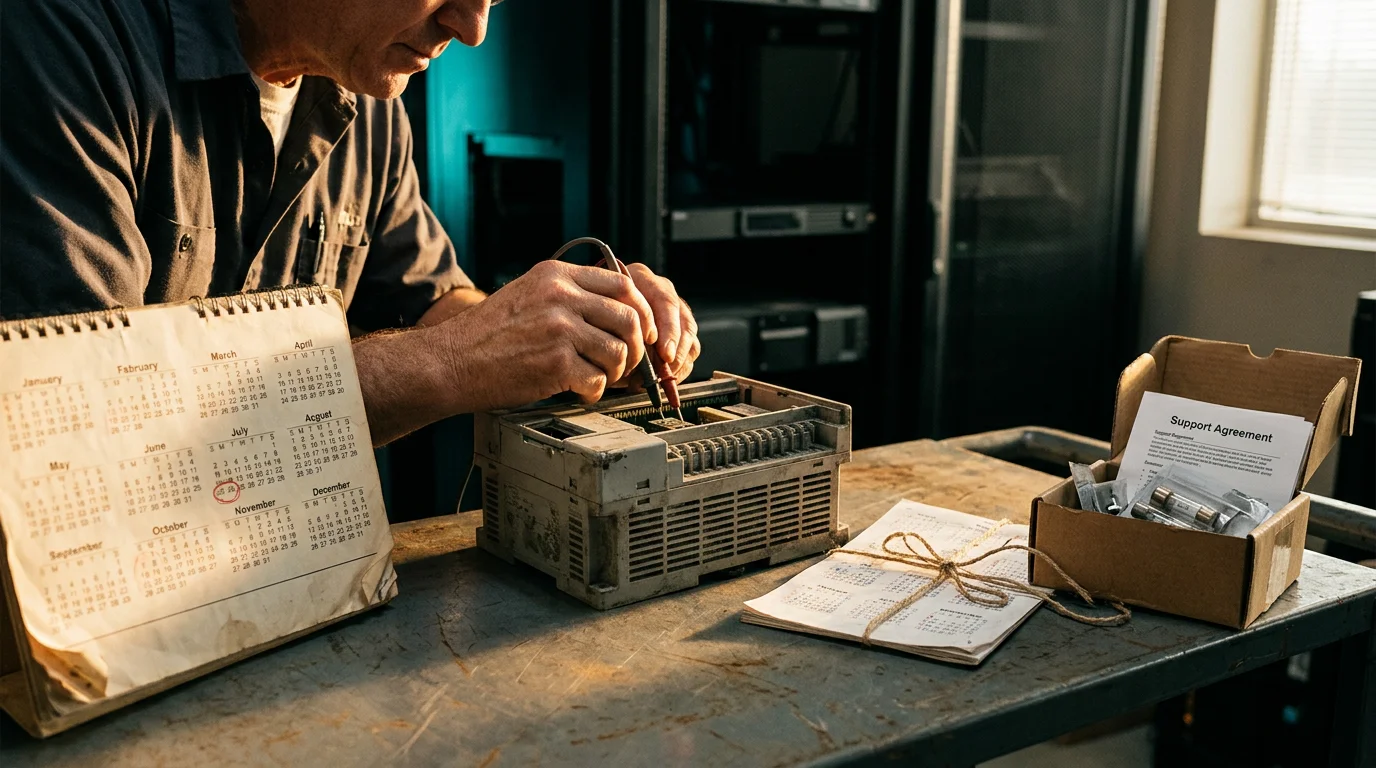
An end-of-life announcement is a change in who carries the risk, not a timer wired to the power switch. The system will probably still start the next morning. What changes is the vendor's obligation to fix it, accept a ticket, reproduce a defect, certify it with newer dependencies, or take your call at 2 a.m. Those losses arrive at different times, and a single red date on a slide hides all of them.
That is why I do not let a vendor banner set the migration schedule. I build a support ledger, read the signed contract, test the unsupported path, and price the period during which we would own a defect that nobody else is obliged to repair. Sometimes the sensible answer is to stay for another year. Sometimes the announced date exposes a dependency that can stop revenue within a quarter. The date alone cannot tell you which case you have.
An end-of-life date changes obligations, not physics
On the named date, the product does not normally disable itself; the supplier changes the service it promises around that product. A perpetual licence may still permit use. A subscription may not. Hosted software can behave differently again because the supplier controls the running service. Put the commercial model beside the lifecycle notice before anyone talks about urgency.
The useful question is not "Will it run?" It is "Which failure modes become ours on that date?" A standard support exit can remove defect fixes, security patches, compatibility testing, new hardware certification, regulatory statements, and escalation to engineering. Those are separate losses. Record each one separately because different teams absorb them.
Security gets most of the attention, but operability often creates the first bill. A payroll application may keep calculating correctly while its database client stops working with the only operating system image that infrastructure will approve. A desktop program may run until replacement hardware lacks a driver for its licence dongle. A mainframe workload may remain stable while the one supported transfer gateway moves to a protocol it cannot negotiate.
Nothing in those examples happens by magic at midnight. The date removes a repair path. The next ordinary change, certificate renewal, browser update, hardware replacement, auditor request, or production defect reveals that the repair path has gone.
Hosted products need a different test because continued operation and continued support are tied together. The supplier may retire an endpoint, stop accepting an older client, remove an export format, or change identity requirements. Ask for the shutdown sequence, data export period, read access after termination, and deletion schedule. A promise to "support migration" says little unless the agreement states which data, format, and time window the supplier must provide.
Firmware and appliances add another boundary. The application licence may be perpetual while signatures, time sources, device certificates, or replacement units require an active service. Test an appliance with its upstream services blocked and document what degrades. That simple exercise often finds a dependency nobody recorded when the device was purchased.
Treat any claim of an automatic shutdown as a fact to prove. Check the licence terms, entitlement files, remote activation requirements, subscription renewal, and any service the application calls home to. If the vendor can technically block use, capture the mechanism and the exact contractual right. Do not repeat a salesperson's warning as an architectural fact.
Lifecycle labels need a translation table
"End of sale," "end of maintenance," "end of support," and "end of life" do not have standard meanings across vendors. Even product lines from the same supplier can use different definitions. The only reliable interpretation is the one in the lifecycle policy that applies to your edition, release, licence, region, and contract.
Normalize every notice into a small table before presenting it to an investment committee:
| Question | Evidence to capture |
|---|---|
| Can we keep running it? | Licence clause, subscription term, activation dependency |
| Will security fixes continue? | Covered severity, delivery channel, exclusions |
| Will the vendor accept cases? | Entitled case types, hours, response target |
| Will it certify new surroundings? | Operating systems, databases, browsers, hardware |
| Is paid extension available? | Eligibility, duration, price basis, prerequisites |
This exercise exposes marketing deadlines quickly. A vendor may call a release "obsolete" while a purchased maintenance extension still covers severe security defects for two years. Another may keep a support portal open while refusing code changes of any kind. Both can advertise "support," yet they transfer very different risks.
Watch for scope tricks. The core runtime may retain support while the compiler, reporting engine, database driver, management console, or operating system underneath it does not. Conversely, one unsupported development tool does not necessarily make a stable compiled application unsafe to operate. The build path and the production path deserve separate rows.
Also separate policy from capacity. A vendor can promise best-effort help without promising a fix, a response time, or access to the engineers who know the old branch. That may be enough for installation questions and useless for a corrupt ledger. Write down the remedy you can compel, not the kindness you hope to receive.
Map dates at component level and then calculate the first collision. Suppose an application release receives defect fixes until December, its database version receives security fixes until June, and the operating system remains covered longer. June governs the current stack unless the database can move independently. Calling December "the application deadline" gives the board six months of comfort that the deployed combination does not have.
Do not confuse release support with migration rights. Access to a current version may be included in maintenance, while licences for a new deployment model, database connector, or test environment cost extra. Ask finance to obtain a complete entitlement statement before engineers design an upgrade around rights the company has not bought.
The signed contract outranks the lifecycle webpage
Your support position comes from the agreement, amendments, order forms, and incorporated policies, in that order of legal relevance as your counsel interprets them. A public lifecycle page is evidence of vendor policy, but it may not amend a negotiated commitment. It can also change after the purchase. Save a dated copy and the policy version incorporated into the deal.
Ask procurement or counsel to answer concrete operational questions, not "Are we covered?" Coverage is too vague. Can the vendor reject a severity-one case because the release is old? Must it provide a workaround or only acknowledge the ticket? Does a security clause require fixes for all vulnerabilities or only ones the vendor rates above a threshold? Does support depend on running a certified database and operating system combination?
A support contract also has boundaries that engineers routinely miss:
- It may cover the unmodified product but exclude local patches and generated code.
- It may require an upgrade before the vendor investigates.
- It may provide advice without a commitment to deliver code.
- It may exclude dependencies supplied by another company.
- It may end when a named hardware lease or cloud service ends.
Get the answers in writing. A friendly account manager's email helps, but a signed amendment helps more. If the business intends to accept a large operational exposure because somebody said "we'll look after you," that sentence belongs in the risk register with an owner and an expiry date.
Test support before relying on it. Open a representative, noncritical case that requires the vendor to inspect the exact old release and configuration. Record whether the portal accepts the version, whether first line support can route it, what diagnostic bundle the vendor demands, and whether your team can still produce that bundle. This is not theatre. A paid contract that cannot get past entitlement checks during a calm afternoon will not improve during an outage.
Ask who owns a stalled escalation. Procurement owns commercial pressure, engineering owns reproducible evidence, operations owns access to the failed environment, and an executive owns acceptance of unresolved exposure. Naming those owners prevents a familiar loop in which each group waits for another to make the vendor act.
Extended support deserves the same scrutiny. It can be a useful bridge when it buys actual fixes and expert access. It is poor insurance when the vendor promises only commercially reasonable efforts, limits eligible configurations, or can require an upgrade before touching the fault. Price the contract after listing the remedies, not before.
Unsupported software fails through ordinary change
The usual failure is a chain of small, reasonable changes. Infrastructure replaces an operating system image because the old one no longer receives patches. The new image rejects an old encryption library. The application team cannot rebuild its native extension because the compiler licence server disappeared years ago. The software still contains correct business logic, but the organization has lost the means to produce a deployable release.
I have seen teams test the application executable and declare the risk low while ignoring the build machine, deployment scripts, certificate process, batch scheduler definitions, source generators, and rollback media. Production continuity requires the whole path from source and configuration to a recoverable release. If any step depends on an unsupported or missing component, that dependency belongs on the ledger.
Security risk also grows by accumulation, not by calendar ceremony. NIST Special Publication 800-40 Revision 4 treats patching as preventive maintenance across the enterprise. That framing matters: once a supplier stops producing a patch, the organization has not completed maintenance by scanning the flaw. It has identified work that it may be unable to perform.
Compensating controls can reduce exposure. Network isolation, strict allowlists, a read-only replica, stronger authentication at a gateway, removal of unused parsers, and extra monitoring can make continued operation reasonable. They do not turn unsupported code into supported code. Each control needs an owner, a test, and a failure response; otherwise it is a sentence in an audit document.
The awkward case is a defect with no published vulnerability identifier. An arithmetic error, record corruption, clock issue, or protocol edge case can damage the business without appearing in a security feed. If the original language experts have left and the vendor will not investigate, the company owns diagnosis, repair, regression testing, and recovery. That engineering exposure often costs more than the security scenario used to win budget.
Consider a nightly settlement job that has run unchanged for a decade. Infrastructure rotates the certificate on the file transfer gateway. The job's old client rejects the new chain, so files queue overnight. Operations can resend them manually, but the resend procedure loses the original ordering and a downstream reconciliation flags duplicates. The vendor accepts the ticket, confirms the release has left maintenance, and recommends upgrading before investigation.
The first technical fault in that sequence is small. The loss comes from missing certificate compatibility, an untested manual procedure, and a support remedy that requires a project during an incident. A restore drill alone would not have exposed it. A realistic continuity test must include external exchanges, ordering, retries, duplicate handling, and the business check that decides whether processing completed correctly.
Blast radius matters more than software age
An unsupported component that sits behind a narrow interface, processes replaceable data, and has a tested manual fallback can be safer than a supported platform with broad privileges and no recovery drill. Age is a weak proxy. Price reach, recoverability, change frequency, and concentration.
Start with reach. List what the software can read, write, approve, transmit, or stop. Include service accounts, database roles, shared file systems, message queues, scheduled jobs, and physical processes. A reporting tool with read access to a replica presents a different exposure from an old workflow engine that can release payments.
Then measure recoverability with evidence. When did the team last restore it on clean hardware? Can it recreate a release from source? Does the rollback procedure cover the database schema and queued messages, or only binaries? A backup that nobody has restored is an intention. Time the recovery exercise and record the dependencies it consumes.
Change frequency tells you how often the unsupported path will meet something new. A sealed calculation kernel fed through a stable file format may run untouched for years. A public web application encounters browser, certificate, identity, and attack changes constantly. The first can still carry severe correctness risk, but the second has more opportunities to discover incompatibility.
Concentration is the final multiplier. If one old service stops a whole warehouse, every customer invoice, or month-end close, its small codebase does not make it a small risk. Map the business processes that have no alternate route. This is where a lifecycle discussion becomes a continuity discussion, which usually changes who has authority to accept the risk.
A support ledger replaces guesswork with evidence
A useful ledger fits on one sheet and points to deeper evidence. Give every row a system owner and an evidence date. If a field contains "unknown," that is work to schedule, not a risk score to average away.
Use these columns:
system, version, business_process, vendor_date, lifecycle_stage,
contract_remedy, security_fix_scope, supported_stack, build_reproducible,
restore_tested_at, privileged_reach, manual_fallback, change_rate,
extension_option, annual_extension_cost, exit_trigger, owner, evidence_at
Populate the ledger from primary material: installed version output, contracts, vendor policy documents, support tickets, build logs, restore results, identity configuration, and network rules. A configuration management database can seed the work, but it rarely proves that a build succeeds or a restore completes.
For a mixed legacy estate, inventory the languages and the surrounding tools separately. COBOL may depend on JCL, copybooks, a transaction monitor, and a particular database precompiler. A VB6 application may depend on COM registrations, installer projects, report templates, and 32 bit drivers. A PHP monolith may hide operating system packages and scheduled commands outside its repository. "One application" often means five support clocks.
Do one reproducibility test before debating migration scope. Take clean, isolated infrastructure and try to build, deploy, start, exercise, back up, and restore the current release using stored instructions. Record every manual intervention and every binary that came from an unknown workstation. This test turns vague staffing anxiety into a list of missing assets.
Keep raw evidence beside each ledger entry. Store the exact command output that identifies a runtime, a copy of the entitlement screen, the ticket response that states an exclusion, and the restore log with its completion time. Record who collected it. When a vendor revises a webpage or an engineer leaves, the decision still has a traceable basis.
Review the ledger when the system or its surroundings change, not only at an annual risk meeting. A new integration, acquisition, authentication service, data class, or transaction peak can change reach and concentration overnight. The owner should also reopen the decision when evidence ages past a period the organization has chosen. Stale proof is a common way a controlled exception quietly becomes an unexamined one.
The ledger should show dates as evidence boundaries, not traffic lights. Red, amber, and green compress too much. Two red systems may need opposite decisions: one has a tested fallback and no write privileges; the other has no source, no restore, and authority to post financial entries. Executives can understand that distinction if the evidence remains visible.
Price the exposure window, not the announcement
The cost of staying is the cost of carrying the risk until an exit completes. It includes support fees, compensating controls, specialist retention, recovery preparation, expected incident loss, and the option value you give up when staff or replacement parts disappear. Compare that total with the cost and risk of replacement over the same period.
Expected loss is useful when treated as a range, not a prophecy. Use a low, central, and high estimate for incident frequency and impact. Separate events that cause downtime, data repair, regulatory work, manual processing, and lost transactions because each has a different recovery shape.
annual_exposure =
  support_and_extension
  + compensating_controls
  + specialist_and_spares
  + recovery_exercises
  + sum(event_frequency_range * loss_range)

decision_horizon_cost = annual_exposure * years_to_exit
                        + exit_program_cost
Do not hide uncertainty in a single discounted number. Show which assumption changes the decision. If a specialist leaving turns a two hour recovery into an unknown recovery, model that as a trigger. If an extended support offer expires, model the price and risk on both sides of that date.
Use scenarios that finance and engineering can both inspect. One scenario might assume a recoverable compatibility fault, including diagnosis time, manual processing, reconciliation, and lost staff capacity. Another might cover corruption that requires restoring data and replaying transactions. A third may address a security flaw for which isolation is the only available control. Do not average these into a fictional "typical incident" before showing their separate causes and costs.
Price delay itself. If a replacement team needs the current specialists for discovery, every departure can increase both cost and uncertainty. If spare hardware has a long procurement path, consuming one unit reduces the remaining recovery options. These changes may not appear in operating expenditure, but they alter the chance that the company can exit on its own terms.
Avoid a common accounting error: comparing the full replacement project with only the annual maintenance invoice. Staying consumes engineering time, freezes infrastructure choices, keeps exception controls alive, and preserves an incident tail. Replacement also carries transition failures, parallel running, data reconciliation, and new operational skills. Put both complete paths on the page.
Insurance does not erase the exposure. Policies contain exclusions, retention amounts, notice duties, security conditions, and coverage disputes. Ask the insurer or broker how unsupported software affects the specific policy, then record the written answer as one input. Do not let "we have cyber insurance" occupy a row where a recovery plan should be.
The output should be a range management can accept explicitly. For example: staying for twelve months costs a known amount for support and controls, plus an estimated incident range, while preserving a defined migration window. That is a decision. "Vendor says end of life" is only an input.
Staying can be rational when the exit is controlled
Remaining on an unsupported release is defensible when the business can bound the blast radius, reproduce the build, recover the service, staff the code, and fund controls until a dated exit. It becomes neglect when the organization cannot state those conditions or keeps moving the exit without new evidence.
Write an exception with measurable triggers. Useful triggers include loss of a named specialist, expiry of extended support, failure of a restore drill, inability to replace hardware, a vulnerability that the current controls cannot contain, or a business change that increases privileges or volume. A trigger must force review or shutdown; it cannot merely send another reminder.
Give the exception a budget and an end condition. Controls that depend on spare firewall capacity, contractor availability, or manual reconciliation are not free because their invoices sit in other cost centers. The system owner should report whether the controls passed their tests and whether the exit work burned down the dependencies named in the ledger.
Governance should make extension harder each time, but not by adding shame or arbitrary penalties. Require fresh evidence, a new exposure range, proof that the previous period removed a specific dependency, and approval from the person who owns the affected business process. If nothing changed except the requested date, management is no longer accepting a bridge. It is accepting permanent unsupported operation without saying so.
Choose among four honest paths:
- Keep the system and accept the priced exposure for a fixed period.
- Buy extended support while removing dependencies that block exit.
- Isolate or reduce the system so its remaining job has a smaller blast radius.
- Replace or rewrite it, with behavioral evidence that the new system matches the old one.
An upgrade is not automatically the safest path. A forced major version can change data models, integration behavior, licences, and operating procedures while leaving the underlying architecture intact. If the team must absorb that much change, compare it with replacement instead of assuming the vendor's next version deserves the investment.
Nor should a rewrite begin with source translation. Legacy systems contain behavior in code, job control, database routines, configuration, operator habits, and production data. A project that translates syntax but misses month-end ordering has preserved the easiest part and lost the business.
A deadline becomes real when an option disappears
A real deadline is the last responsible date to preserve an option, not necessarily the date printed in a vendor announcement. Hardware availability, contract eligibility, staff notice periods, certificate changes, regulatory commitments, and business freeze windows can create earlier or later decision points. Put those dates on one dependency map and work backward from the exit you can actually execute.
Set decision gates around evidence. By the first gate, complete the support ledger and reproduce a release. By the next, test recovery and obtain written contract answers. Before committing to stay, approve the exposure range and fund every control. Before committing to leave, prove the replacement against recorded production behavior and rehearse rollback.
CodeHero enters this calculation when the chosen exit is a rewrite: it reads the whole mixed-language codebase, modernizes the architecture into Go, Rust, TypeScript, and Postgres where appropriate, and checks behavior with a parity harness against recorded production traffic. Its stated delivery commitment is under 30 days, which is relevant only after the organization has defined the behavioral boundary and the evidence needed to accept the result.
Do not schedule from the vendor's emotional temperature. Schedule from the first option your organization would lose: the last extension you can buy, the last hardware you can recover onto, the last engineer who can explain the close process, or the last safe release window before a business event. That date is defensible because it connects a decision to a consequence. Everything else is a banner.
FAQ
Does software stop working on its end-of-life date?
Usually it keeps running, but the vendor may stop patches, fixes, certification, or engineering escalation. Check the licence and any activation or hosted service dependency because those can create an actual shutdown mechanism.
What is the difference between end of support and end of life?
There is no universal definition across vendors. Translate each label into specific rights: continued use, case acceptance, security fixes, defect fixes, certified environments, and paid extensions.
Can a support contract override a vendor end-of-life notice?
A negotiated agreement may preserve commitments that a public lifecycle notice does not mention, but counsel should interpret the contract and incorporated policies. Save the applicable policy version and get any promised exception into a signed amendment.
Is it safe to run unsupported software?
It can be a rational temporary decision when you can limit privileges, reproduce the build, test recovery, staff repairs, and fund compensating controls. It is not defensible when the organization cannot measure the exposure or state when it will leave.
Does cyber insurance cover unsupported software?
Do not assume it does. Ask the insurer or broker about the exact policy, exclusions, security conditions, retention, and notice duties, then keep the written answer with the risk decision.
How should we calculate the cost of staying on legacy software?
Add support, controls, specialist retention, spares, recovery exercises, and a range for incident losses over the planned exit period. Compare that complete figure with replacement costs, including transition, reconciliation, parallel operation, and rollback.
When is extended support worth buying?
Buy it when the contract provides remedies you can use, such as defined fixes and access to capable engineers, while the team removes exit blockers. Best-effort advice with narrow eligibility may not justify the price.
Which evidence should go into an end-of-life risk review?
Use installed version output, licence and support terms, vendor policies, ticket responses, successful build logs, restore results, dependency inventories, access rights, and tested fallback procedures. Give every item an owner and an evidence date.
Is upgrading always safer than rewriting an old system?
No. A major upgrade can impose data, integration, licence, and operating changes while retaining the architecture that caused the constraint, so compare its full risk with replacement.
What makes an end-of-life deadline real?
The deadline becomes real when delay removes an option you need, such as an extension contract, recoverable hardware, specialist knowledge, or a safe release window. Schedule from that consequence and the evidence behind it, not the vendor banner alone.